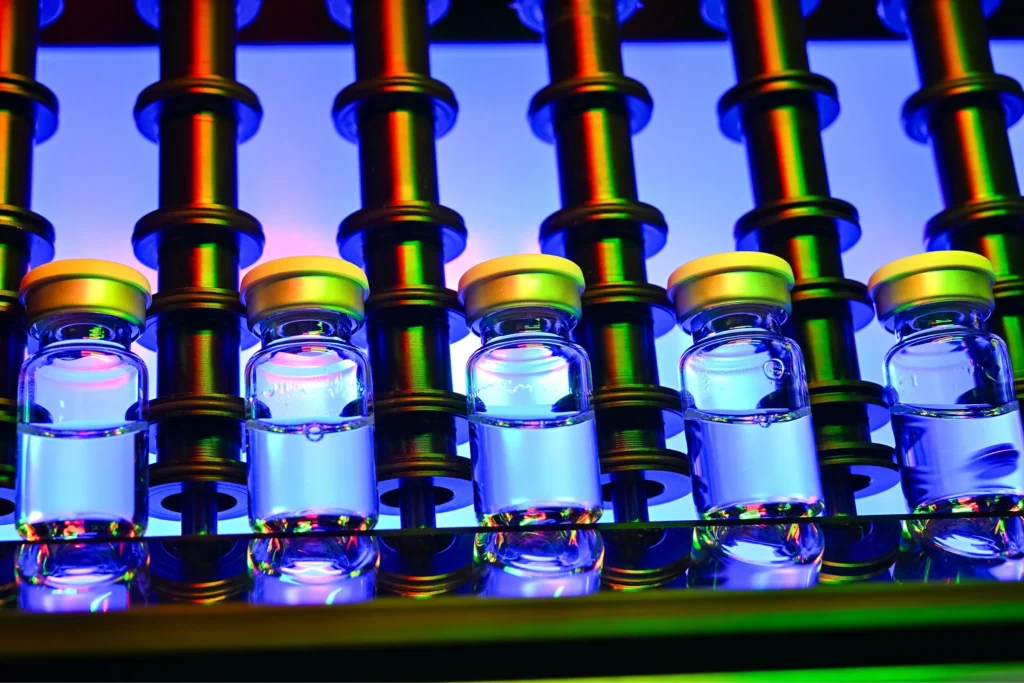
Every filled vial has to pass visual inspection before it ships. The right automated vial inspection machine catches particles, cosmetic flaws and fill problems without rejecting good product. The wrong one either misses defects, fills the reject bin with false ejects, or needs weeks of recipe work for every new product.
This 2026 guide ranks six vial inspection machines from Dabrico, Körber (Seidenader), Brevetti CEA, Syntegon, Stevanato Group and Antares Vision. We explain what each machine does best, then take a separate look at difficult-to-inspect vials like suspensions, lyophilized cakes and powders.
TL;DR: The Best Automated Vial Inspection Machines in 2026
| Rank | Machine | Max speed | Best for |
|---|---|---|---|
| 1 | Dabrico DAI-50 | 50/min | Difficult products and multi-format, small-to-mid batches |
| 2 | Körber Seidenader VI | 600/min | High-speed vial and ampoule lines |
| 3 | Brevetti K32S | 600/min | Particle detection at high speed |
| 4 | Syntegon AIM 9 | 600/min | High-volume clear liquid vials |
| 5 | Stevanato MAVIS | 400/min | Suspensions and viscous products at scale |
| 6 | Antares Vision VRI VI | 400/min | Pairing inspection with serialization |
Quick picks:
- Best for high-volume clear liquids: Körber Seidenader VI, Brevetti K32S or Syntegon AIM 9.
- Best for suspensions, viscous biologics and lyophilized products: Dabrico DAI-50, followed by Stevanato MAVIS.
- Best for keeping false rejects low: Dabrico DAI-50, whose unsupervised AI reports a false eject rate under 1%.
- Best for inspection plus serialization: Antares Vision VRI VI.
How We Evaluated These Vial Inspection Machines
We scored each machine on six factors that matter most to quality and production teams:
- Throughput and scalability: rated speed and how well the platform grows with production.
- Container versatility: the range of vial sizes, glass types and fill volumes it handles.
- Inspection technology depth: camera stations, imaging methods, AI and integrated leak detection.
- Detection accuracy: how reliably it finds particles, cosmetic flaws and closure defects.
- False reject rate: how much good product it ejects by mistake.
- Ease of qualification and validation: how quickly the machine can be validated and put into production.
Specs come from published manufacturer information, current as of November 2026. Speeds are maximum rated speeds and vary by container size and format. We did not bench-test the machines, and where a manufacturer does not disclose a detail, we have not guessed at it.
We gave more credit to results tied to a specific product or customer than to “up to” claims. Every machine here can be configured well beyond its base specification, so treat our rankings as a shortlist. A feasibility study on your own product is the only result that should decide a purchase.
What to Look for in an Automated Vial Inspection Machine
- Batch size and speed: Start with what you fill and how much of it. A 600-per-minute line built for one vial format is overkill for a clinical or small-batch operation running several products.
- Product difficulty: Suspensions, viscous biologics, lyophilized cakes, powders and molded glass vary from unit to unit. Bubbles, product texture and natural variation can trigger false rejects on machines tuned for clear liquids.
- Recipe effort: Ask how many good units, defect samples and labeled images a new recipe needs, who builds it, and whether it can be built offline without taking the machine off the line.
- Container closure integrity testing (CCIT): Updated EU GMP Annex 1 expectations have pushed manufacturers toward integrated CCIT. High-voltage leak detection (HVLD) suits liquid products, while headspace gas analysis (HGA) suits lyophilized products.
- AI readiness: If false rejects are a major cost driver, prioritize machines with AI or deep learning that can tell real defects from normal product variation.
The 6 Best Automated Vial Inspection Machines for Pharma
1. Dabrico DAI-50
Best for: difficult-to-inspect products and multi-format, small-to-mid-volume production.
The DAI-50 takes a different approach from the high-speed machines on this list. It runs on Boon Logic’s AVIS platform, which uses unsupervised AI. Instead of learning what defects look like, it learns what a good vial looks like and flags anything that deviates, so it does not depend on large libraries of known defects. That matters most for vials that look different from unit to unit, such as suspensions, viscous drugs, lyophilized cakes and powders.
Dabrico, based in Bradley, Illinois, has built visual inspection equipment for 47 years. It reports that a new product recipe can be trained in about 60 minutes from 500 pre-inspected good units, with no labeled images or vision engineer needed. The DAI-50 handles 1 ml to 1,000 ml molded and tubular glass vials holding clear or opaque liquids, suspensions, lyophilized cakes and powders, imaged by five 60 fps cameras. Dabrico reports detection accuracy of 99% and a false eject rate under 1% on standard injectable products, and under 3% on difficult ones. Recipes are frozen for validation, and qualification takes under six weeks on average.
Consider: it is built for lower-volume production (up to 50 units per minute), not for 300+ per minute fill lines, which would need several units running in parallel. It also does not include container closure integrity testing.
2. Körber Seidenader VI
Best for: high-speed vial and ampoule lines.
Körber‘s inspection business is the former Seidenader of Markt Schwaben, Germany. The VI is its highest-capacity vial platform, inspecting liquid and lyophilized product at up to 600 containers per minute with up to 13 camera stations and up to 10 outfeeds for defect-based sorting. Its Bubble-X technology uses light refraction to separate bubbles from real particles, and Körber reports it halves the average false reject rate, from 2% to 1%. 3D inspection adds depth to particle detection, and HVLD Slim and UpsideDown options bring leak detection to low-fill vials and ampoules.
The B.R.AI.N platform adds supervised deep learning, which can be retrofitted to existing machines. Körber says it cuts false ejects by up to 90% versus conventional inspection, though that is an “up to” figure without a named customer result. Because the models train on classified defect images, building them depends on your image library and Körber’s specialists. For sites running both containers, the Switch 100 and Switch 500 run vials and nested syringes on one machine. Pricing is quoted per project.
3. Brevetti K32S
Best for: particle detection at high speed.
Brevetti CEA, based in Sovizzo, Italy, has built inspection machines since the 1950s. The K32S runs at up to 600 per minute, with three dedicated particle inspection stations and a hollow-spindle bottom view that suits vaccines and suspensions. Its Particle Trajectory Tracking follows particles through the liquid, capturing up to 100 images per particle unit with high-frame-rate cameras and using motion prediction to separate particles from bubbles. It handles vials, ampoules and cartridges up to 32 mm in diameter, with water-like, oily, suspension and freeze-dried products.
Supervised bubble filtering and Brevetti AI Studio, which runs deep learning networks alongside traditional vision tools and complies with 21 CFR Part 11 and EU GMP Annex 11, help cut false rejects. The K32S LD adds HVLD, and headspace gas analysis covers freeze-dried product. Recipe setup uses a guided parameterization tool but still relies on vision expertise. Brevetti publishes no detection or false reject figures, so ask for feasibility data on your product. Pricing is quoted per project.
4. Syntegon AIM 9
Best for: high-volume clear liquid vials.
Syntegon, formerly Bosch Packaging Technology, launched the AIM 9 in February 2026. It inspects vials from 2 ml to 250 ml at up to 600 containers per minute using its patented Static Division (SD) technology, with both area-scan and line-scan cameras. Bubble masking separates harmless bubbles from particles, deep learning is available as an option, and built-in reinspection helps cut false rejects. Integrated HVLD, headspace gas analysis or both make it a strong all-in-one choice for large clear-liquid lines.
Its standout feature for recipe work is AIM PREP, a compact offline unit that replicates a full AIM setup, including camera, lighting and spin speeds, so teams can build and tune recipes without stopping production. Because deep learning is optional, most recipes still rely on conventional vision tools and an experienced engineer. The AIM 9 is new, so references on this exact platform are still limited, and pricing is not published.
5. Stevanato Group MAVIS
Best for: suspensions and viscous products at scale.
Stevanato Group, based in Piombino Dese, Italy, makes both glass containers and inspection machines. MAVIS runs at up to 400 per minute with up to 20 inspection stations in a compact footprint, and the MAVIS Combi version inspects vials up to 51.6 mm in diameter as well as syringes, cartridges and ampoules. Its patented imaging for suspensions and viscous or gel-like products, using matrix and line-scan cameras, sets it apart from machines tuned mainly for clear liquids, and it inspects lyophilized cakes from the top, side and bottom.
Stevanato says the MAVIS interface needs no programming or scripting, and two HMIs simplify operation. It integrates HVLD and HGA for container closure integrity. Its optional Vision AI platform claims up to 99.9% accuracy and a tenfold cut in false rejects, though these are platform-level claims rather than customer results. The platform is cloud-based on Microsoft Azure, which your IT and data integrity teams will need to review.
6. Antares Vision VRI VI
Best for: pairing inspection with serialization.
Antares Vision, based in Travagliato, Italy, became part of Crane NXT when that acquisition closed on March 31, 2026. Its Visual Rotating Inspection (VRI) unit inspects up to 400 liquid-filled glass containers per minute. It is the only machine on this list that can combine inspection with code verification, OCR/OCV and serialization, and combined versions add HVLD, vacuum decay or pressure decay leak testing. Optional Digital Factory modules add AI for inspection and predictive maintenance.
Antares publishes no detection or false reject figures for its vial machines. With the 2026 ownership change, confirm the service model and product roadmap before committing.
Best Machines for Difficult-to-Inspect Vials
Suspensions, viscous drugs, lyophilized cakes, powders and molded glass are where vial inspection machines differ most. Natural variation in these products is easy to mistake for a defect, so the inspection technology matters more than raw speed.
- Dabrico DAI-50 (50/min): unsupervised AI learns each product’s normal variation instead of relying on defect libraries. On powder-filled molded glass vials, Dabrico reports 98% detection at a 2.7% false reject rate.
- Stevanato MAVIS (400/min): dedicated suspension imaging with matrix and line-scan cameras, top, side and bottom inspection of lyophilized cakes, plus HVLD, HGA and available AI.
- Körber Seidenader VI (600/min): Bubble-X refraction-based bubble discrimination, 3D inspection and B.R.AI.N AI.
- Brevetti K32S (600/min): Particle Trajectory Tracking, supervised bubble filtering and a hollow-spindle bottom view for suspensions.
- Syntegon AIM 9 (600/min): Static Division technology, bubble masking and optional deep learning.
Final Thoughts: Choosing the Right Vial Inspection Machine in 2026
In 2026, vial inspection performance depends less on speed or camera count and more on how well a machine understands real product variation. AI-driven anomaly detection is the clearest way to cut false rejects while keeping detection rates high.
For high-volume clear liquids, the Körber Seidenader VI, Brevetti K32S and Syntegon AIM 9 are proven choices. If inspection needs to tie into serialization, look at the Antares Vision VRI VI. For difficult products, multiple formats or small-to-mid batches, the Dabrico DAI-50 offers the strongest mix of AI inspection, low false rejects and fast qualification.
Whichever machine you shortlist, ask for a feasibility study on your own product and defect sets, with detection and false eject rates reported together, before you commit.
Frequently Asked Questions
What is an automated vial inspection machine?
An automated vial inspection machine uses cameras, lighting and software to check every filled vial for particles, cosmetic defects, fill level problems and closure issues. It replaces or supports manual and semi-automated inspection booths, which are slower and depend on operator attention.
How fast are automated vial inspection machines?
High-volume machines such as the Körber Seidenader VI, Brevetti K32S and Syntegon AIM 9 run at up to 600 vials per minute. Machines built for smaller batches and difficult products typically run under 200 per minute.
What is a good false eject rate for vials?
It depends on the product. Körber puts the average for conventional systems at about 2%, and says fixed-threshold systems can reach 15%. Under 1% on clear liquids is a strong target, while suspensions, lyophilized products and molded glass usually run higher.
What’s the difference between supervised and unsupervised AI in vial inspection?
Supervised deep learning trains on images that experts have labeled as good or defective, so it needs a defect library. Unsupervised learning trains on good units only and flags anything that deviates. That makes it faster to set up and able to catch defects it has never seen.
How long does it take to qualify a vial inspection machine?
It varies by machine, product count and site procedures. Plan for IQ, OQ and PQ after the factory and site acceptance tests. Dabrico, for example, says its sites qualify in under six weeks on average. Ask each vendor for its typical timeline and documentation package.
Does automated visual inspection test container closure integrity?
Not on its own. Cameras find visible defects, but leaks need methods such as HVLD, headspace gas analysis or vacuum decay. Updated EU GMP Annex 1 expectations have made integrated CCIT more important, and the Körber, Brevetti, Syntegon, Stevanato and Antares machines here all offer it as an integrated option.