Choosing an automated visual inspection (AVI) machine is one of the biggest equipment decisions a parenteral manufacturer makes. The right system catches particles, cosmetic defects and container closure failures without rejecting good product. The wrong one either misses defects or fills the reject bin with false ejects, and both are expensive.
This 2026 guide compares the leading inspection machines from five manufacturers: Körber (Seidenader), Stevanato Group, Syntegon, Brevetti CEA and Dabrico. We rank them overall, explain what each machine does best, and take a separate look at difficult-to-inspect products like suspensions and lyophilized cakes.
TL;DR: The Best Automated Inspection Machines for Pharma in 2026
| Rank | Machine | Max speed | Best for |
|---|---|---|---|
| 1 | Dabrico DAI-50 | 50/min | Difficult products and multi-format, small-to-mid batches |
| 2 | Körber Seidenader VI | 600/min | High-speed vial and ampoule lines |
| 3 | Brevetti K32S | 600/min | Particle detection at high speed |
| 4 | Syntegon AIM 9 | 600/min | High-volume clear liquid vials |
| 5 | Stevanato MAVIS | 400/min | Suspensions and viscous products at scale |
| 6 | Brevetti K15 DR | 600/min | High-speed syringe inspection |
| 7 | Körber Switch 350 | 350/min | Combined vial and syringe production |
| 8 | Stevanato Plus 400 | 400/min | Continuous-motion inspection with integrated HVLD |
Quick picks:
- Best for high-volume clear liquids: Körber Seidenader VI, Brevetti K32S or Syntegon AIM 9.
- Best for syringes: Brevetti K15 DR at high volume; Dabrico DAI-50 or Körber Switch 75 for smaller batches.
- Best for suspensions, viscous biologics and lyophilized products: Dabrico DAI-50, followed by Stevanato MAVIS.
- Best for keeping false rejects low: Dabrico DAI-50, whose unsupervised AI reports a false eject rate under 1%.
How We Evaluated These Inspection Machines
We scored each machine on six factors that matter most to quality and production teams:
- Throughput and scalability: rated speed and how well the platform grows with production.
- Container versatility: the range of vials, syringes, ampoules and fill volumes it handles.
- Inspection technology depth: camera stations, imaging methods, AI and integrated leak detection.
- Detection accuracy: how reliably it finds particles, cosmetic flaws and closure defects.
- False reject rate: how much good product it ejects by mistake.
- Ease of qualification and validation: how quickly the machine can be validated and put into production.
Specs come from published manufacturer information. Speeds are maximum rated speeds and vary by container size and format. Where a manufacturer does not disclose a detail, we have not guessed at it.
What to Look for in an Automated Inspection Machine
- Container type and volume: Start with what you fill and how much of it. A 600-per-minute line built for one vial format is overkill for a clinical or small-batch operation running several formats.
- Product difficulty: Suspensions, viscous biologics, lyophilized cakes and oily solutions are hard to inspect. Bubbles, product texture and natural variation can trigger false rejects on machines tuned for clear liquids.
- Container closure integrity testing (CCIT): Updated EU GMP Annex 1 expectations have pushed manufacturers toward integrated CCIT. High-voltage leak detection (HVLD) suits liquid products, while headspace gas analysis (HGA) suits lyophilized products.
- AI readiness: If false rejects are a major cost driver, prioritize machines with AI or deep learning that can tell real defects from normal product variation.
The 8 Best Automated Visual Inspection Machines for Pharma
1. Dabrico DAI-50
Best for: difficult-to-inspect products and multi-format, small-to-mid-volume production.
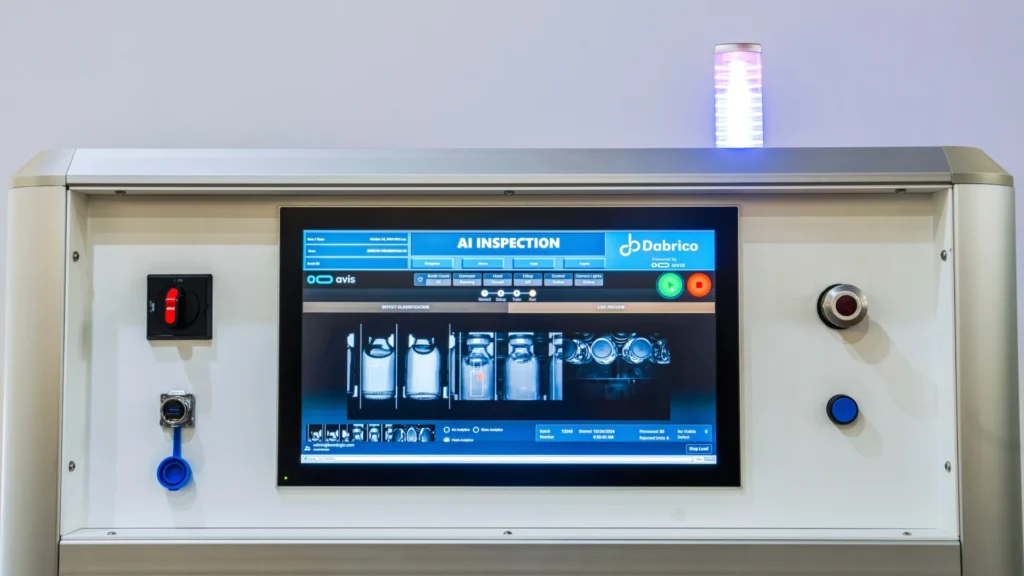
The DAI-50 takes a different approach from the high-speed machines on this list. Its AVIS system uses unsupervised AI that learns the normal variation of each product, so it does not depend on large libraries of known defects. That matters most for products that look different from container to container, such as suspensions, viscous drugs, lyophilized cakes and powders.
One platform handles vials, syringes and ampoules from 1 ml to 1,000 ml. Dabrico reports that a new product recipe can be trained in about 60 minutes, that qualification takes under six weeks, and that the false eject rate stays under 1%, with detection accuracy of 99%.
Consider: it is built for lower-volume production (up to 50 units per minute), not for 300+ per minute fill lines.
2. Körber Seidenader VI
Best for: high-speed vial and ampoule lines.
Körber‘s Seidenader VI runs at up to 600 containers per minute with up to 13 camera stations. Its Bubble-X technology uses light refraction to separate bubbles from real particles, and 3D inspection adds depth to particle detection. HVLD Slim and UpsideDown options bring leak detection to low-fill vials and ampoules. The B.R.AI.N platform adds AI, and the DE.SY.RE handling system is rated up to 1,000 containers per minute for gentle transport. A syringe version, the VI-S, offers up to 10 cameras and HVLD inside the carousel.
3. Brevetti K32S
Best for: particle detection at high speed.
The K32S also runs at 600 per minute, with three dedicated particle inspection stations and a hollow-spindle bottom view. Its Particle Trajectory Tracking follows particles through the liquid, capturing 100 images per particle unit with high-frame-rate cameras. Supervised bubble filtering and Brevetti‘s Intelligent Vision Framework help cut false rejects. It handles vials and ampoules, including oily solutions.
4. Syntegon AIM 9
Best for: high-volume clear liquid vials.
Syntegon‘s AIM 9 inspects up to 600 containers per minute using its patented Static Division (SD) technology, with both area-scan and line-scan cameras. Bubble masking reduces false rejects, and deep learning is available as an option. It handles vials up to 250 ml, and integrated HVLD and headspace analysis options plus built-in reinspection make it a strong all-in-one choice for large clear-liquid lines.
5. Stevanato Group MAVIS
Best for: suspensions and viscous products at scale.
MAVIS runs at up to 400 per minute with up to 20 inspection stations. Stevanato‘s patented imaging for suspensions and viscous products, using matrix and line-scan cameras, sets it apart from machines tuned mainly for clear liquids. It integrates HVLD and HGA for container closure integrity, and its cloud-based Vision AI adds AI-driven inspection.
6. Brevetti K15 DR
Best for: high-speed syringe inspection.
The K15 DR inspects syringes at up to 600 per minute with zero-contact handling and no worm screws, which protects syringes from scratches and mechanical stress. Integrated tub-and-nest handling and gap compensation keep it running smoothly in ready-to-use syringe lines. The standard K15 offers a no-contact option with manual or in-line loading.
7. Körber Switch 350
Best for: facilities running both vials and syringes.
The Switch 350 combines vial and syringe inspection on one platform, running at up to 350 per minute with more than 33 inspection stations. For smaller batches, the Switch 75 runs at 75 per minute with a dual carousel, 12 cameras, an integrated de-nester and re-nester, and B.R.AI.N AI readiness.
8. Stevanato Plus 400
Best for: continuous-motion inspection with integrated leak detection.
The Plus 400 inspects up to 400 containers per minute in continuous motion. Cameras on movable arms stay synchronized with each container, and servo-driven separation routes defects out. It includes 35 kV HVLD and can integrate a turbidimeter. The Plus 200 is a compact, index-motion option at 200 per minute, with motorized spindles and HVLD on the LKD model.
Best Machines for Difficult-to-Inspect Injectables
Suspensions, viscous drugs, lyophilized products and emulsions are where inspection machines differ most. Natural variation in these products is easy to mistake for a defect, so the inspection technology matters more than raw speed.
- Dabrico DAI-50 (50/min): unsupervised AI learns each product’s normal variation instead of relying on defect libraries, with a reported false eject rate under 1%.
- Stevanato MAVIS (400/min): dedicated suspension imaging with matrix and line-scan cameras, plus HVLD, HGA and available AI.
- Körber Seidenader VI (600/min): Bubble-X refraction-based bubble discrimination, 3D inspection and B.R.AI.N AI.
- Brevetti K32S (600/min): Particle Trajectory Tracking and supervised bubble filtering, with 100 images per particle unit.
- Syntegon AIM 9 (600/min): Static Division technology, bubble masking and optional deep learning.
Final Thoughts: Choosing the Right Inspection Machine in 2026
In 2026, inspection performance depends less on speed or camera count and more on how well a machine understands real product variation. AI-driven anomaly detection is the clearest way to cut false rejects while keeping detection rates high.
For high-volume clear liquids, the Körber Seidenader VI, Brevetti K32S and Syntegon AIM 9 are proven choices. For high-speed syringes, the Brevetti K15 DR leads. For difficult products, multiple container formats or small-to-mid batches, the Dabrico DAI-50 offers the strongest mix of AI inspection, low false rejects and fast qualification.
Whichever machine you shortlist, ask for a trial using your own product and defect sets before you commit.
Frequently Asked Questions
What is an automated visual inspection machine?
An automated visual inspection (AVI) machine uses cameras, lighting and software to check filled parenteral containers for particles, cosmetic defects, fill level problems and closure issues. Many also integrate container closure integrity testing such as HVLD or headspace gas analysis.
How fast are automated inspection machines?
High-volume machines such as the Körber Seidenader VI, Brevetti K32S and Syntegon AIM 9 run at up to 600 containers per minute. Machines built for smaller batches and difficult products typically run under 200 per minute.
Which inspection machine has the lowest false reject rate?
Among the machines in this guide, the Dabrico DAI-50 reports the lowest figure, a false eject rate under 1%, thanks to unsupervised AI that learns normal product variation.
Do I need HVLD or headspace gas analysis?
Updated EU GMP Annex 1 expectations have made integrated container closure integrity testing more important. HVLD is typically used for liquid products, while headspace gas analysis is suited to lyophilized products.